Role — Lead UX Researcher & Product Designer


PROBLEM STATEMENT
CONTEXT
JLA Tactics Board is a platform that enables content creators, football coaches and football enthusiasts to create football analysis animations or annotate analysis over existing media.
WHAT WAS HAPPENING?
Football enthusiasts were signing up, but engagement with the product was low.

MY RESPONSIBILITIES
RESEARCH
Conducted usability trials with football enthusiasts to understand barriers to engagement and product usability.
SYNTHESIS
Analysed user feedback and research findings, using AI to help identify recurring themes and patterns.
PROBLEM FRAMING
Defined research objectives and translated findings into clear design challenges and opportunities.
IDEATION
Explored new workflows, engagement features and ideas to give football fans more reason to participate.
UX / PROTOTYPING
Translated research insights into Figma concepts and a responsive interactive prototype, iterating on the user experience.
STAKEHOLDER COLLABORATION
Worked with the developer to understand the product, share research findings and develop potential opportunities for improvement.
UNDERSTANDING THE PRODUCT
Before defining the problem, I first needed to understand how JLA worked, who it was designed for and where the business was seeing the biggest opportunities. I spoke with the founder to understand the product, its users and the engagement data behind the challenge.
01 — what is the purpose?
A platform where users can create football tactics, animations and training-ground routines.
Users can also share their creations through the community feed and engage with content from others.
02 — who is it for?
The product is aimed at:
Content creators
Football coaches
Football enthusiasts
03 — where was the opportunity?
Sign-ups were strong, but engagement after registration was low.
Football enthusiasts were signing up but rarely engaging with the community feed, compared with content creators who represented the majority of active users.
INITIAL RESEARCH FRAMEWORK
Research objective
Why aren't football enthusiasts progressing from sign-up to creating and sharing content on JLA Tactics Board?

USER TRIALS
I conducted four remote usability tests with football enthusiasts who regularly consume football content but had not used JLA Tactics Board before. Sessions combined a pre-test questionnaire, task-based usability testing and semi-structured interviews, focusing on the end-to-end journey from discovering the product to creating and sharing an animation. Tasks were intentionally open-ended, allowing participants to navigate the experience in their own way rather than following a prescribed route.
01
INITIAL PRODUCT EXPLORATION
I explored the product to understand what it does, how it works, and the current user experience.

02
EXPERT WORKFLOW
I mapped out an expert workflow with the developer to understand the key steps, tools and decision points when creating and sharing content.

03
RESEARCHER PILOT
I ran a short researcher pilot to test my approach, refine the questions and stress-test the tasks used in the user trials.

04
AFFINITY MAPPING
I grouped observations from the researcher pilot into themes, highlighting potential issues, hypotheses and areas to investigate.

05
AREAS TO INVESTIGATE
I turned the pilot findings into focused areas to investigate during the user trials, each with observable behaviours, key questions and indicators of success.

06
STUDY STRUCTURE
Using the research question and areas to investigate, I created a set of tasks for the user trials.


AI-ASSISTED ANALYSIS
I used AI to organise and synthesise the qualitative data from the user trials, using participant observations, notes and transcripts to identify recurring patterns.
This helped me quickly surface potential themes across understanding, usability, motivation and value, rather than reviewing each participant in isolation.
I then reviewed the outputs against the original evidence, challenging and refining the findings before deciding what to take forward. AI accelerated the process, but the interpretation and final decisions remained mine.
KEY INSIGHTS
INSIGHT 01
Users struggled to understand how an animation is constructed
The biggest usability barrier wasn't necessarily finding individual controls. It was understanding the underlying animation model.
Guidance appears valuable once users recognise they need it, but they may not recognise that need at the beginning.
INSIGHT 02
Users often lacked confidence in the system state
Participants could perform actions without always understanding what had happened as a result.
Setup decisions can create problems later that users do not connect back to the initial choice.
INSIGHT 03
Making the product easier may not solve the motivation problem
I asked the question at the end of the study - "if the process of creating and publishing an animation was easy, would you still do it outside the study?" All participants said no.
INSIGHT 04
Creating tactical content is a new behaviour
Existing football behaviour is social, spontaneous and low-effort.
The current JLA experience introduces a significant amount of effort into an existing low-effort behaviour.
WHAT THIS CHANGED
Usability and motivation appeared to be two separate barriers.
Barrier 1 — Usability
"I want to, but it's difficult."
Aimed towards making the process of a beginner football enthusiasts creating an uploading an animation easier to understand.
Barrier 2 — Value
"Even if it were easy, why would I?"
Aimed towards questioning the motivation a football enthusiast has to create an animation and share it.
MARKET RESEARCH & OPPORTUNITY
Following a discussion with the founder, we decided to explore the value barrier in more depth. This shifted the focus from improving content creation to understanding how JLA could create value for football enthusiasts who don't currently create tactical content.

RESEARCH FOCUS
I expanded the research beyond the original usability problem to understand how football enthusiasts currently engage with football and what drives those behaviours.
I looked at:
Existing behaviours — how fans currently consume, discuss, share and participate in football.
Underlying motivations — what they are trying to get from those activities, such as learning, entertainment, social connection and competition.
Creation behaviour — whether fans already create or share structured football content themselves.
Potential opportunities — where JLA's interactive tactics board could provide something that existing football behaviours and platforms do not.
USER RESEARCH
Fans regularly watch, discuss and share football, but participants had no existing behaviour of creating tactical content themselves.
MARKET RESEARCH
Five recurring motivations emerged: social connection, entertainment, knowledge, competition and identity.
OPPORTUNITY
Use JLA's unique interactive tactics board to create football experiences that tap into these motivations, rather than simply asking fans to create content.
WORKFLOWS & GAMIFICATION IDEATION
The research suggested that football enthusiasts needed a stronger reason to engage with JLA than simply creating tactical content. I explored how the existing tactics-board technology could become the core mechanic of a more interactive, repeatable football experience.
THE OPPORTUNITY
Following the research, I explored how gamification could give football enthusiasts a more compelling reason to engage with JLA.
The aim was to build on existing football behaviours and motivations, using the platform’s digital tactics-board technology to create experiences that go beyond conventional content creation.
I explored a range of ideas, considering how interactive challenges, competition and social participation could make engaging with football tactics more accessible, rewarding and enjoyable.


SOCIAL CONNECTION
Users can create leagues with friends, send challenges and compare their scores, making the experience more social and giving them a reason to return.
entertainment
The tactics board turns football knowledge into an interactive experience, giving fans something to play rather than simply answer.
KNOWLEDGE
Challenges tap into fans’ existing desire to test their football knowledge, with points awarded for correct answers and tactical decisions.
competition
Scores give users something to compete over, from personal bests and global rankings to direct challenges with friends.
identity
Users can build a visible record of their football knowledge, scores and achievements, giving them something to compare and share with others.
LOW-EFFORT
A daily five-question format gives fans a simple, repeatable reason to engage. Each challenge is designed to be quick to understand and complete, reducing the effort required to participate.

MAPPING THE END-TO-END EXPERIENCE
I mapped the proposed JLA Football Challenge journey from initial discovery through to returning for the next daily challenge.
Key opportunities identified:
01
Make the value clear from the start
Users need to understand what the challenge offers and why it is worth their time.
02
Build confidence before gameplay
Aimed towards questioning the motivation a football enthusiast has to create an animation and share it.
03
Make competition social and comparable
Enable users to challenge friends, compare scores and track their performance against others through leagues and leaderboards.
04
Give users a reason to return
Aimed towards questioning the motivation a football enthusiast has to create an animation and share it.
How it informed the design
The journey map helped translate the initial concept into a more complete experience, connecting the interactive gameplay with the supporting features needed around it. It also highlighted that engagement would depend on more than the questions themselves: users would need a clear reason to start, meaningful feedback after playing, and an incentive to return.
PROPOSED DIRECTION
THE OPPORTUNITY
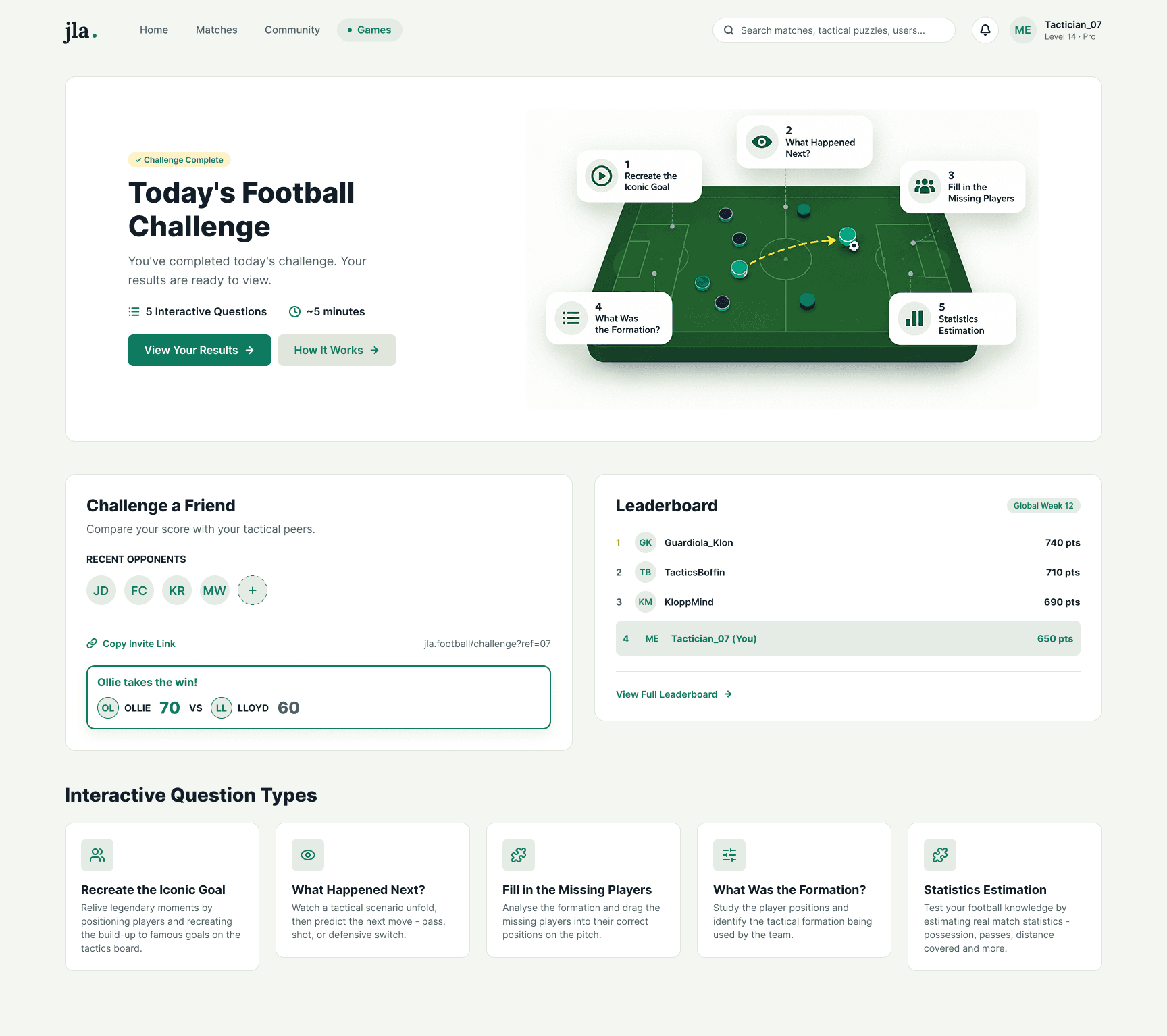
JLA Football Challenge is a proposed daily football experience built around JLA’s existing digital tactics-board technology. Each day, fans complete five interactive football questions, with different challenges requiring them to use the tactics board rather than simply select an answer.
The format could combine challenges such as recreating iconic goals, predicting what happens next, identifying players in a formation and solving tactical situations. This turns the tactics board from a content-creation tool into something football enthusiasts can actively play with.

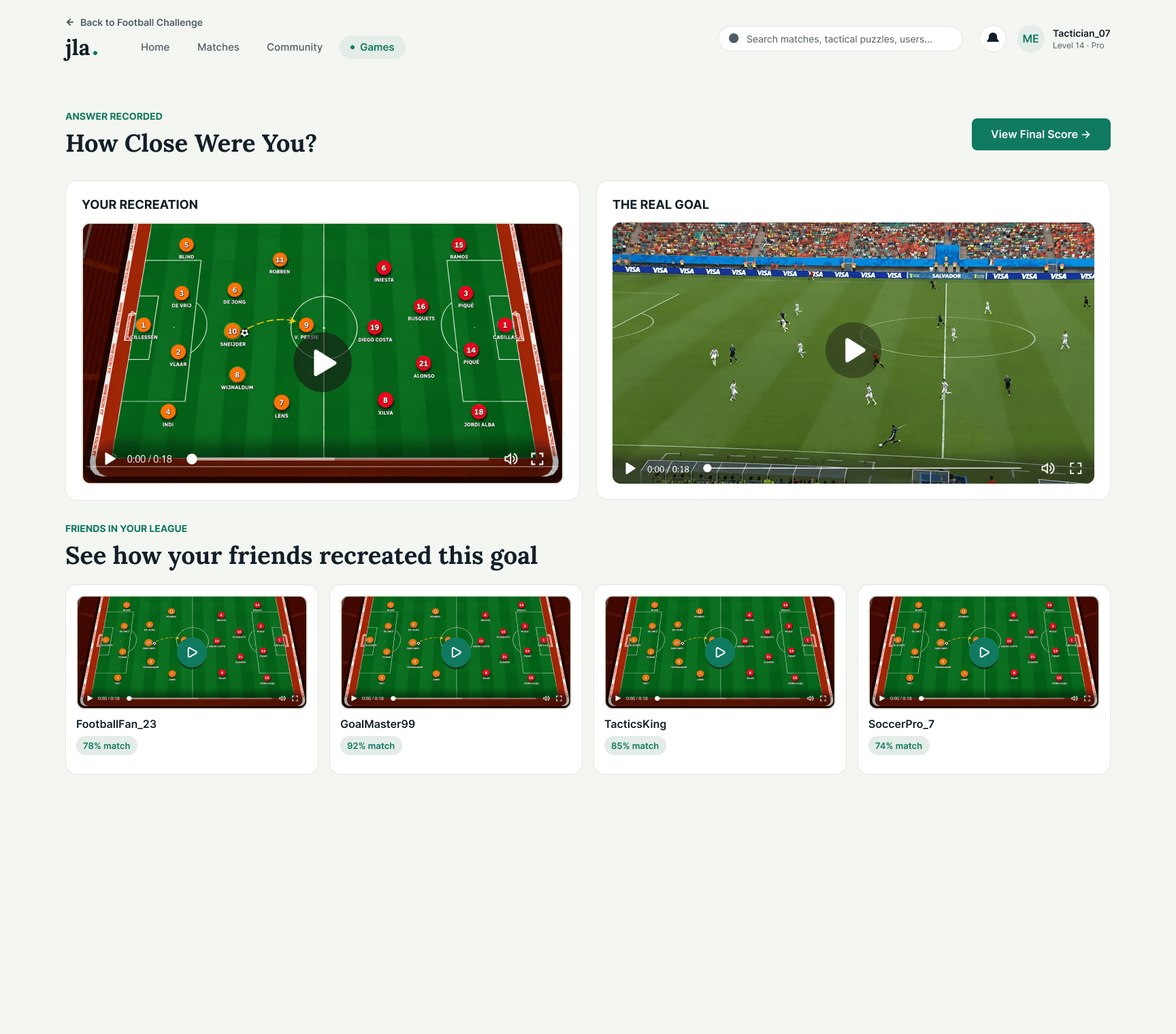
INTERACTIVE GAME EXAMPLE - RECREATE THE ICONIC GOAL
Players are reminded of an iconic goal and use JLA’s digital tactics board to recreate the build-up, player movements and passing sequences from memory. Their recreation is scored on its accuracy, turning memorable football moments into an interactive challenge that tests the users football trivia knowledge in an interactive way.
The game uses the same animation creation mechanics that are required to create an animation on the existing platform.
FINAL CONCEPT
Exploring how research insights could translate into a new football experience.
RESEARCH INSIGHTs
Convenience and low effort
Tap into existing football behaviours by offering an experience that makes participation worthwhile without adding significant time or effort.
Understanding value and guidance
Make the product’s value clear from the start, with contextual guidance throughout to help users understand how to use it confidently.
DESIGN OUTCOME
Designed a proposed daily football challenge using JLA’s existing tactics-board mechanics, combining interactive questions, scoring and friend challenges to make football knowledge more engaging and rewarding.
Designed a clear landing page to communicate the platform’s value, supported by How To pages that guide users through key features and interactions.


RESEARCH INSIGHT
Differentiation through existing mechanics
Use JLA’s existing digital tactics board to create interactive football experiences that conventional quiz platforms cannot easily replicate.
DESIGN outcome
Integrated JLA’s existing digital tactics board into each interactive challenge, making its core mechanics central to the gameplay experience.


RESEARCH INSIGHT
Motivation through identity and competition
Tap into fans’ desire to test their knowledge, compete with friends and connect socially to create a stronger reason to participate.
DESIGN outcome
Introduced instant scoring and performance feedback, allowing users to compare results, challenge friends directly, and compete within private leagues.

RESEARCH INSIGHT
Engagement through repeatable entertainment
Create a recurring reason to participate through fresh, engaging challenges that encourage fans to return and create on the platform.
DESIGN outcome
Introduced daily interactive football challenges that give fans value and a meaningful reason to participate, test their knowledge and return to JLA through fresh experiences built around the digital tactics board.
AI-ASSISTED PROTOTYPE DEVELOPMENT

AI-ASSISTED prototyping
Used ChatGPT to translate research insights into a structured prompt for Figma AI, accelerating the development of landing page concepts and interactive game screens.
AI-generated outputs were reviewed and refined against the research findings, with design decisions and validation remaining human-led.
RESPONSIVE DESIGN


DESIGN RATIONALE
Mobile-first behaviour
User trials highlighted that football fans typically engage with football through their phones, making mobile accessibility essential.
Responsive layouts
Landing pages, instructions and results adapt to smaller screens for convenient access.
Landscape gameplay
The interactive tactics board requires horizontal space, so users are prompted to rotate their phone for a more usable experience.
PROJECT OUTCOME / REFLECTION
Outcome
STAKEHOLDER FEEDBACK
The research helped highlight the risks of trying to serve multiple user groups with competing needs. This informed the founder’s decision to focus JLA on content creators, rather than continuing to add features for every audience.
WHAT CHANGED
The research helped inform a new strategic direction for JLA, with the company beginning to focus on content creators as its primary user group rather than trying to serve football enthusiasts with competing needs.
NEXT STEPS
The JLA Football Challenge concept has been put on hold while the developer focuses on refining the existing platform for content creators. The concept remains an opportunity for future exploration.
WHAT I LEARNED
01 - PROBLEM FRAMING
Look beyond the stated problem
Stakeholder requests are a starting point, not always the root problem. Investigating why engagement was low revealed a deeper value barrier: football enthusiasts lacked a compelling reason to use JLA at all.
02 - AI & RESEARCH
Use AI to accelerate, not replace
AI helped accelerate the synthesis of research and generate ideas, but critically reviewing the evidence myself was essential to preserve participant insights and turn them into meaningful design decisions.
03 - STAKEHOLDER COMMUNICATION
Adapt design thinking to your audience
Working with a founder without a design background taught me to communicate the reasoning behind design decisions, using research and evidence to build shared understanding rather than simply advocating for a solution.
CLOSING STATEMENT
This project taught me to look beyond surface-level problems, use research to uncover meaningful opportunities, and translate user insights into experiences that deliver genuine value while balancing user needs with business priorities.
Contact
Interested in working together?
I'm always happy to chat about research-led product design, UX opportunities, or simply exchange ideas about building better products. If my work resonates with you, I'd love to hear from you.